Further Research Activities 2024
Approximately one month before harvest, field activities are focused on intensive monitoring of the physiological condition of cereal and oilseed crops in the final stages of their development. This is a critical period during which plants enter an advanced generative phase, directing their physiological activity toward the formation and maturation of reproductive organs.
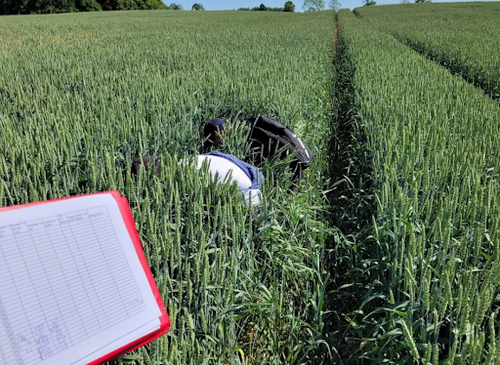
The research team conducts systematic plant sampling, including both vegetative tissues (such as leaves and stems) and generative structures (including ears, panicles, and pods). Samples are collected at designated reference points, enabling accurate representation of spatial variability across the field.
At this stage, a pronounced decline in nitrogen content is observed in vegetative plant tissues. This reflects the remobilization of nitrogen from leaves and stems to developing seeds, which become the primary physiological sink. Concurrently, decreasing chlorophyll concentration in leaves leads to measurable changes in the spectral signal captured by spectrophotometers, enabling the identification of zones with varying rates of maturation and nutrient use efficiency.
In oilseed rape, particular attention is given to pod development and the dynamics of lipid synthesis within seeds. In contrast, in wheat and barley, key parameters include grain filling and the progression of flag leaf senescence—factors that will be further quantified through detailed post-harvest yield analysis.
Currently, collected samples are undergoing laboratory chemical analysis to determine nitrogen content. When integrated with spectral measurement data, these results provide deeper insight into nutrient translocation dynamics during the final growth stages and support the prediction of yield potential and crop quality ahead of harvest.