Fertilization Mapping Application – ScanSpectrum in Practice
The ScanSpectrum system has been developed as a comprehensive tool for generating nitrogen fertilization maps, integrating in-field measurement data with advanced cloud-based analytics.
The application is accessible via an online platform, where users—after logging into their accounts—receive instructions to install two mobile applications: ScanSpectrum (for spectral measurements) and ScanSpectrum Collect (for field data acquisition and management of measurement points).
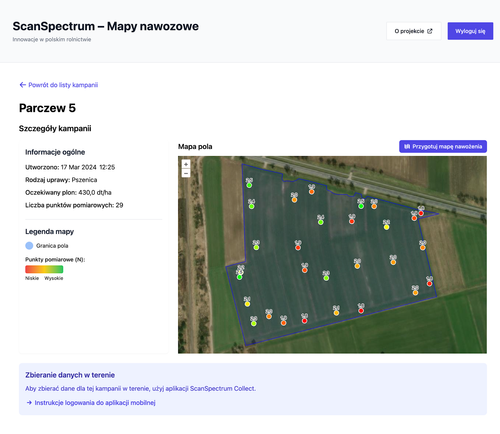
The workflow begins with the definition of fields within the online system, which are then assigned to the mobile application via QR code. In the field, users perform measurements using a connected spectrometer, following the input of agronomic parameters such as crop growth stage, plant density, and visible stress symptoms.
Data collected at reference points are automatically transmitted to the server and become immediately available within the web interface, where users can analyze results and monitor progress in real time. Based on these measurements, the system generates nitrogen content maps, divides the field into management zones, and automatically determines fertilizer application rates for each zone.
Users can then download ready-to-use application maps in formats compatible with their fertilizer spreader systems. The system accounts for variability in crop condition, growth stage, and spatial distribution of sampling points, thereby increasing the precision and effectiveness of fertilization.
ScanSpectrum supports not only real-time nutrient management but also long-term strategic planning by enabling analysis of fertilization outcomes and documentation of agronomic decisions. Maps generated from autumn measurements can be used for spring fertilization of winter crops, while in spring crops the system supports both monitoring of primary fertilization efficiency and optimization of top-dressing applications.
This solution provides farmers with a practical tool for precise, efficient, and well-documented nitrogen management at the field level.